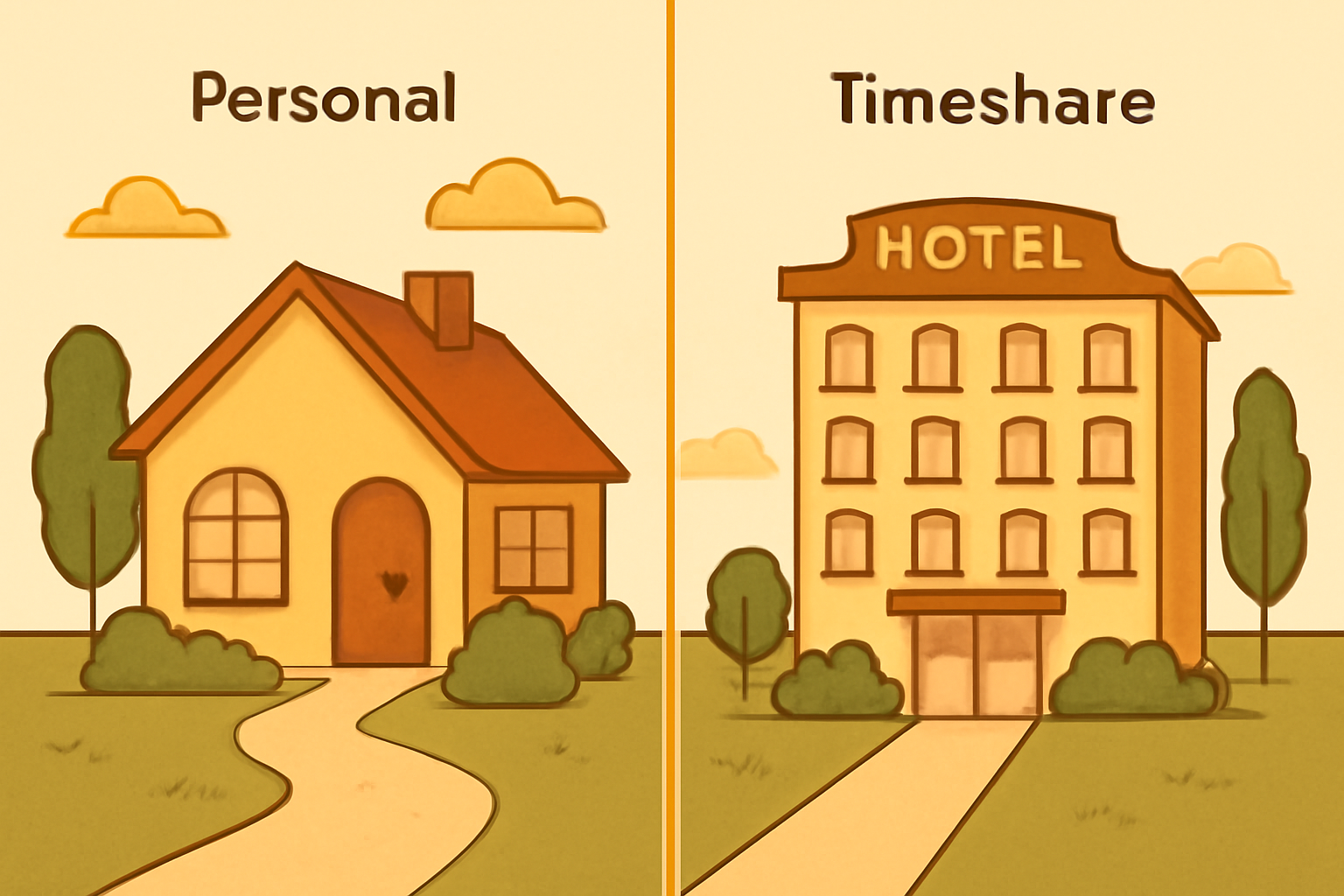
When people hear “shared vacation property,” two very different models come to mind. One is the timeshare — a structure that has been around since the 1960s and carries a fair amount of baggage. The other is co-ownership, where a small group of people (often family) actually own a property together.
These are fundamentally different arrangements, but they get confused constantly. If you are exploring options for a vacation property, understanding the differences will save you tens of thousands of dollars and years of frustration.
What Is a Timeshare?
A timeshare gives you the right to use a property (usually a resort unit) for a specific period each year — typically one or two weeks. You do not own the property itself. You own a “time interval” or a points allocation that grants you access.
There are two main timeshare models:
Deeded timeshares give you fractional ownership of a specific unit for a specific week. You technically own a piece of real estate, but your usage is limited to your assigned period.
Right-to-use timeshares give you no ownership at all. You purchase the right to use a property for a set number of years (often 20-40), after which the right expires and you own nothing.
Points-based timeshares (a modern variation) let you buy a block of points redeemable for stays across a network of resorts. This adds flexibility but also complexity and often higher costs.
What Is Co-Ownership?
Co-ownership means two or more parties purchase a property together and share actual ownership. Each owner holds a percentage of the property — typically reflected in the deed. You collectively make decisions about the property, share costs proportionally, and divide usage according to your own agreement.
Co-ownership groups are usually small: 2-6 families or individuals. The property is a specific home, cabin, or condo that you chose, purchased, and maintain together.
The Key Differences
Cost Structure
Timeshares involve a significant upfront purchase price — the average timeshare costs $24,140 according to the American Resort Development Association — plus annual maintenance fees that typically range from $1,000 to $2,500 per year. These maintenance fees increase annually and you have no control over the amount. Over a 20-year period, a timeshare can cost $60,000-$80,000 or more.
Co-ownership means you are buying actual real estate. Your upfront cost is your share of the purchase price (split among co-owners), and ongoing costs include your proportional share of taxes, insurance, maintenance, and utilities. While these costs add up, you control them directly and they are building equity in a real asset.
The critical distinction: timeshare maintenance fees are a pure expense with no return. Co-ownership costs maintain and improve a property you actually own.
Control
Timeshares give you almost no control. The resort management company decides maintenance priorities, renovation schedules, fee increases, and property rules. You are essentially a customer with a long-term contract, not an owner with decision-making power.
Co-ownership gives you full control. Your group decides everything — when to upgrade the kitchen, which landscaper to hire, what the guest policy is, how to handle scheduling. This requires coordination (which is work), but it means the property reflects your preferences and priorities.
If the idea of a management company making decisions about your vacation property bothers you, co-ownership is the better fit. If you prefer someone else handling everything and don’t mind paying for it, timeshares offer that convenience.
Flexibility
Timeshares are often marketed as flexible, especially points-based systems. In practice, flexibility is limited. Peak weeks require booking far in advance. Points values change. Blackout dates apply. Exchanging your week for a different resort involves fees and availability uncertainty.
Co-ownership flexibility depends entirely on your group’s agreement. If your scheduling system allows swaps and trades, you have genuine flexibility. If you want to visit for a long weekend instead of a full week, you can. If you want to host friends, you can. The only constraints are the ones your group sets.
Appreciation and Investment Value
This is where the difference is most dramatic.
Timeshares depreciate. Significantly. A timeshare purchased for $25,000 will typically sell on the resale market for $3,000-$5,000 — if it sells at all. Many timeshare owners cannot give them away because the new owner would inherit the perpetual maintenance fees. There is an entire industry built around helping people exit timeshare contracts, and it charges thousands of dollars for the service.
Real estate generally appreciates. Vacation homes in desirable markets have historically increased in value, especially waterfront properties, mountain cabins, and homes in popular vacation destinations. As a co-owner, your share of the property grows in value alongside the market. You are building wealth, not watching it erode.
According to the National Association of Realtors, the median existing-home sales price has increased over 40% in the past five years alone. Your co-ownership share participates in that appreciation. Your timeshare does not.
Management
Timeshare management is handled entirely by the resort company. This is convenient — you never worry about hiring a plumber or scheduling lawn care. But you pay dearly for that convenience through escalating maintenance fees, and you have no say in how the money is spent.
Co-ownership management is your responsibility. This can range from very hands-off (hiring a property management company to handle everything) to very hands-on (each family takes turns maintaining the property). Most groups land somewhere in the middle.
The management burden is the primary drawback of co-ownership. It takes time to coordinate schedules, track expenses, manage maintenance, and communicate with your co-owners. This is real work — but it is work that modern tools make significantly easier.
DoorPact was built specifically to handle the operational side of co-ownership: shared calendars, expense tracking, task management, communication, and guest hosting. At $39 per year per property, it costs a fraction of timeshare maintenance fees while giving co-owners the coordination tools that make self-management practical.
Exit Options
Timeshare exits are notoriously difficult. Resale values are negligible. Many contracts include “in perpetuity” clauses that pass obligations to your heirs. Exit companies charge $3,000-$10,000 with no guarantee of success. Some owners simply stop paying maintenance fees and take the credit hit.
Co-ownership exits are governed by your property agreement. A well-written agreement includes right of first refusal for other owners, a valuation method for buyouts, and a clear process for selling your share. Because you own actual real estate with real value, there is a real market for your share.
The exit situation alone should give anyone pause about timeshares. When you cannot leave an arrangement without paying someone to help you escape, the arrangement was never designed with your interests in mind.
When Each Model Makes Sense
Timeshares might work if you:
- Want zero management responsibility
- Prefer resort amenities (pools, restaurants, concierge)
- Like variety and want to vacation in different locations each year
- Are comfortable with the cost and understand you won’t recover it
- Don’t view your vacation property as an investment
Co-ownership is better if you:
- Want to build equity in a real asset
- Value control over your property and its management
- Plan to vacation in the same location year after year
- Are co-owning with family or trusted friends you communicate well with
- Want to pass a real asset to future generations
- Are willing to put in the coordination effort (or use tools to minimize it)
The Modern Co-Ownership Advantage
A decade ago, the management burden of co-ownership was a significant disadvantage. Coordinating by phone, tracking expenses in spreadsheets, managing schedules through email — it was genuinely painful, and timeshares won on convenience.
Today, purpose-built tools have largely eliminated that gap. A shared property management platform handles the calendar, the finances, the tasks, the communication, and the guest logistics. The coordination that used to require hours of phone calls and spreadsheet wrangling now happens automatically.
The result is that co-owners get the best of both worlds: real ownership with real equity, combined with streamlined management that doesn’t consume your free time.
Making the Decision
If you are weighing a timeshare purchase, run the numbers honestly. Add up the purchase price plus 20 years of maintenance fee increases. Compare that total to what your share of a co-owned property would cost — including mortgage, taxes, insurance, and maintenance — while accounting for the property’s likely appreciation.
In almost every scenario, co-ownership is the better financial decision. The question is whether you have co-owners you trust and tools to manage the logistics.
If you have the people, DoorPact provides the tools. One platform for scheduling, finances, maintenance, communication, and guest hosting — everything your shared property needs to run smoothly without the overhead of a resort management company. Try it free and see how simple co-ownership management can be.